
Quick answer: Most factories in Pune and PCMC need an industrial RO plant of 500 to 2000 LPH. A1Aqua's standard 1000 LPH plant is listed at ₹1,20,000 and the 2000 LPH plant at ₹1,80,000. 3000–5000 LPH and full stainless-steel plants are built on request. In Chakan, Bhosari and Talawade the raw water is often borewell or tanker water, so the plant is sized from an on-site water test, not a catalogue.
An industrial RO plant in a factory has a harder job than one in an office. It runs longer hours, feeds canteens and sometimes production, and often works on borewell or tanker water that changes with the season. This guide is for plant heads, admin and facility managers in Pune's industrial belts. It covers how to size the plant, how to treat difficult water and what to budget.
Commercial vs industrial RO plant: what changes
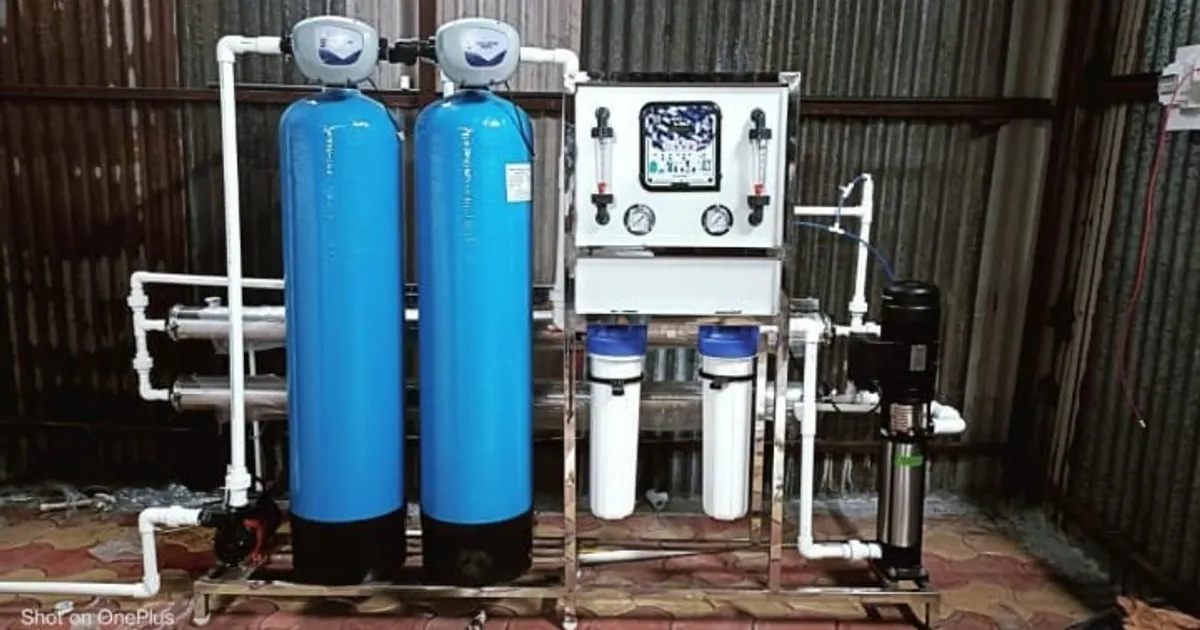
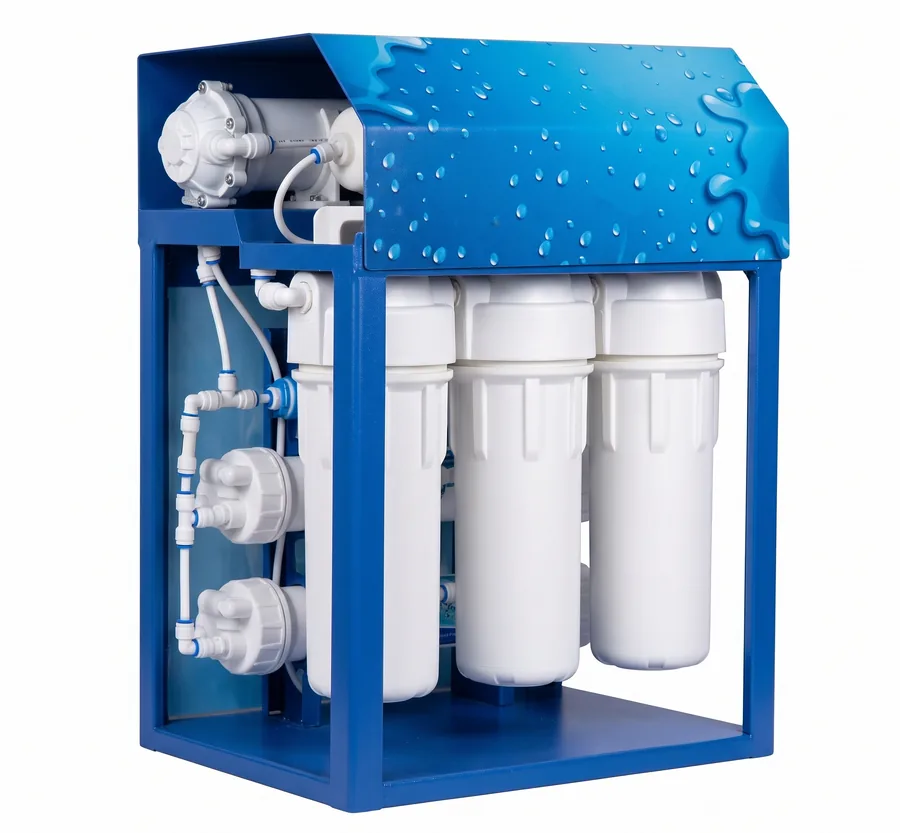
The line is mainly about capacity and build. Compact commercial units up to about 120 LPH use domestic-style membranes and booster pumps. From 150 LPH upwards, plants use 4040 or 4080 industrial membranes, a pump motor, jumbo cartridge bowls, antiscalant dosing and a control panel on a skid. Factory plants usually start at 500 LPH and add sand and carbon filter vessels, a softener where needed, and options such as flow meters, TDS meters and dry-run protection.
Industrial areas we serve in Pune & PCMC
We install and service industrial RO plants across Pune and Pimpri-Chinchwad from our base in Wakad. These are the belts we work in most:
| Area | Typical sites | Common water concern | Typical plant |
|---|---|---|---|
| Chakan MIDC | Auto and component plants, warehouses, worker canteens | Borewell or tanker supply with variable TDS and hardness | 1000–2000 LPH with softener |
| Bhosari MIDC | Engineering and fabrication units, small factories | Mixed municipal and borewell supply | 250–1000 LPH |
| Talawade | IT park offices and industrial units | Tanker top-ups during summer | 500–1000 LPH |
| Alandi | Ashrams, dharmashalas, institutions, small units | Borewell water, large crowds on festival days | 500–2000 LPH with large storage |
| Hinjewadi and Talegaon | IT campuses, plants and warehouses | Borewell or tanker supply in many phases | 500–2000 LPH |
Water quality varies a lot within the same MIDC, sometimes between neighbouring plots. Treat this table as a starting point. We always test the water at your site before quoting.
How to size an industrial RO plant
Add up drinking water, canteen water and any process water, then divide by the hours the plant can run each day. Factories on two or three shifts can run the plant 16–20 hours, which keeps the plant size, and the cost, down.
- Drinking water: about 3 litres per worker per shift.
- Canteen: about 5–7 litres per meal if RO water is used for cooking and dishwashing rinse.
- Process water: take the figure from your production team. Parts washing, cooling make-up and labs vary widely.
- Headroom: plan at 85% of rated output to allow for cold-season dips and membrane ageing.
| Example site | Daily need | Running hours | Plant |
|---|---|---|---|
| Bhosari unit, 300 workers, one shift, canteen lunch | 900 L drinking + 1,500 L canteen = 2,400 L | 8 | 500 LPH (300 LPH needed, 85% rule) |
| Talawade campus, 1,200 staff, cafeteria | 3,600 L drinking + 4,000 L cafeteria = 7,600 L | 12 | 1000 LPH |
| Chakan plant, 1,500 workers, three shifts, plus 4,000 L process water | 4,500 L + 9,000 L canteen + 4,000 L = 17,500 L | 18 | 2000 LPH |
These are illustrative calculations, not customer records. Your survey figures will differ.
Borewell and high-TDS water treatment for factories
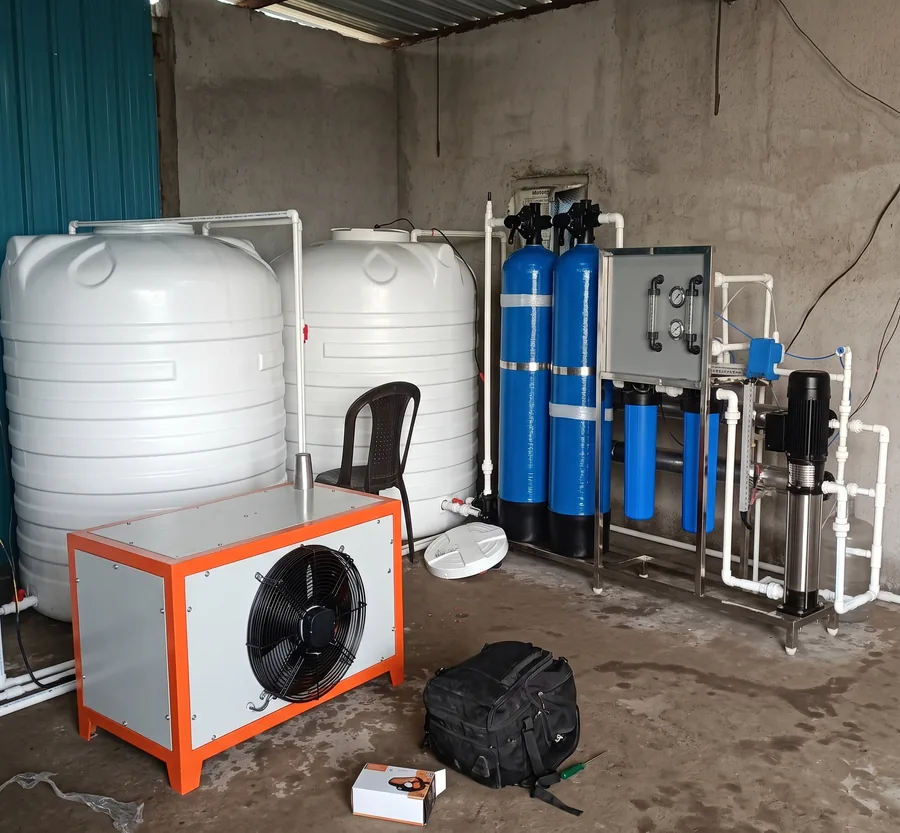
Borewell water around Pune's industrial belts can carry high dissolved solids, hardness and sometimes iron. Fed straight into an RO, that water scales and fouls the membranes within months. A typical treatment chain for difficult water looks like this:
- Pressure sand filter: removes silt and turbidity, which rise after the monsoon.
- Iron removal filter: only if the test shows iron, indicated by brown stains and a metallic taste.
- Activated carbon filter: removes chlorine (from tanker or municipal water), odour and organics.
- Softener or antiscalant dosing: stops hardness from scaling the membranes.
- Micron cartridges: the last guard before the high-pressure pump.
- RO membranes: remove dissolved salts and bring TDS down to drinking levels.
- UV after RO: optional, recommended where water sits in tanks or runs through long pipelines.
High TDS also lowers recovery, the share of feed water that comes out purified. Plan your raw-water supply and reject-water reuse (gardening, toilet flushing, floor washing) as part of the project. For homes and housing societies with the same problem, see our water treatment solutions and water softener systems.
MS or SS skid?
| MS powder-coated skid | Full SS skid | |
|---|---|---|
| Cost | Lower | Higher |
| Best for | Drinking and canteen water in dry plant rooms | Food, beverage and pharma areas, humid or wash-down zones |
| Frame life | Good with periodic repainting | Longer, resists corrosion |
| Our options | Standard on most plants | Available, including a full SS 1000 LPH plant |
Industrial RO plant cost in Pune
Indicative prices for our standard configurations: 500 LPH at ₹95,000, 1000 LPH at ₹1,20,000 and 2000 LPH at ₹1,80,000. A softener, an iron removal filter, a full SS skid, UV, extra tanks and civil work for the plant base are added as your water and site require. Every item is listed separately in the quote. For the smaller sizes, see our RO plant price guide from 25 to 2000 LPH.
Budget beyond the purchase: electricity (a 1 HP pump uses about 0.75 kW), antiscalant, cartridges every 1–3 months, media replacement and membranes every 2–3 years with good pre-treatment. In a factory, a missed cartridge change costs far more in downtime than the cartridge itself.
Keeping a factory RO plant running
- Train an operator: someone on each shift should log pressure gauges and product TDS, and check the dosing tank.
- Keep critical spares on site: one set of micron cartridges and a spare solenoid valve.
- Put the plant on an AMC: scheduled visits, membrane cleaning and priority attendance when there is no water. Read what a good commercial RO plant AMC should cover.
- Re-test the water every season: borewell TDS often rises in summer and drops after the monsoon.
Plan an industrial RO plant
Send us your headcount, shifts, canteen meals and water source. We test the water on site and size the plant to your real demand.
Frequently asked questions
What is the price of an industrial RO plant in Pune?
A1Aqua lists standard plants at ₹95,000 for 500 LPH, ₹1,20,000 for 1000 LPH and ₹1,80,000 for 2000 LPH. A softener, iron removal, SS skid, UV and site work are quoted separately after a free water test and site survey.
Do you install industrial RO plants in Chakan MIDC?
Yes. We install and service industrial RO plants in Chakan MIDC, Bhosari, Talawade, Alandi, Talegaon, Hinjewadi and across Pune and Pimpri-Chinchwad.
Can an RO plant treat high-TDS borewell water?
Yes, with the right pre-treatment. High-TDS or hard borewell water needs sand and carbon filtration, a softener or antiscalant dosing, and sometimes iron removal ahead of the RO membranes. Recovery is lower, so raw-water supply must be planned.
What is the largest RO plant you supply?
Our standard range goes up to 2000 LPH. We build 3000–5000 LPH plants and full stainless-steel plants on request after reviewing your water report and demand.
How long does it take to install an industrial RO plant?
Skid-mounted 250–2000 LPH plants usually take 1–3 working days to install, including plumbing, electricals, dosing calibration and commissioning, once the site is ready.