

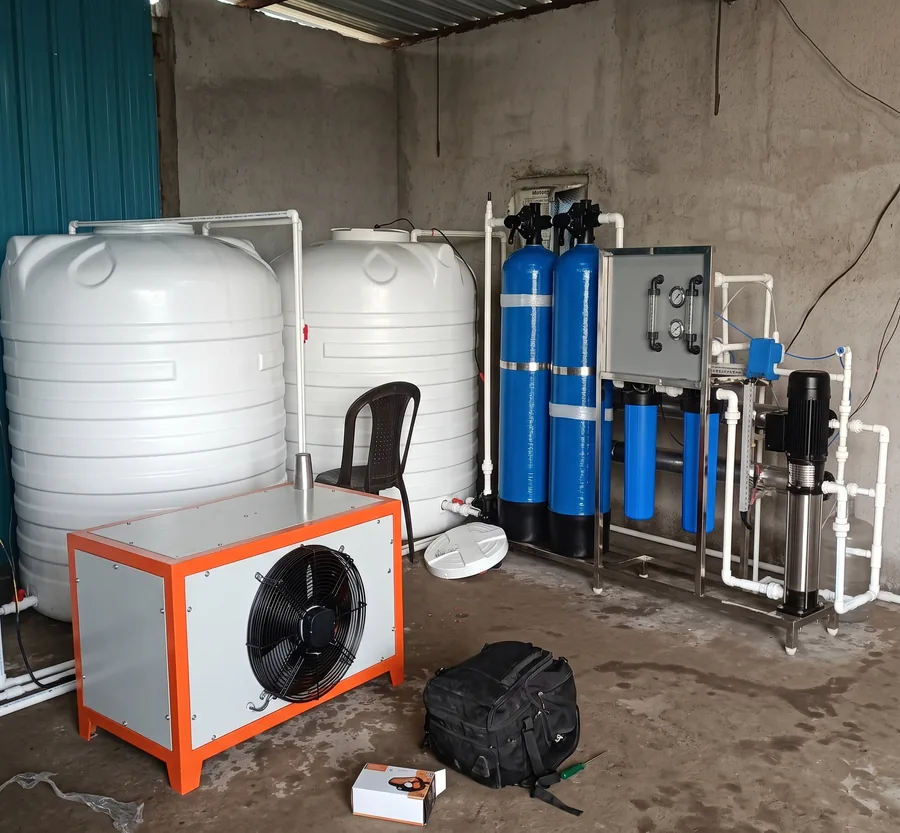
Quick answer: A commercial RO plant AMC should cover scheduled preventive visits, micron cartridge changes, antiscalant checks, sand and carbon filter backwash checks, membrane cleaning, feed and product TDS, pressure and flow readings in a service log, and priority attendance when the plant stops. Visit frequency depends on plant size, running hours and raw-water quality. With good pre-treatment, 4040 and 4080 membranes typically last 2–3 years.
Most commercial RO plants that fail early were not badly built. They were badly maintained. A dosing tank runs dry, a cartridge stays in two months too long, and the membranes scale up. This guide explains what proper servicing looks like for 25 LPH to 2000 LPH plants, what a good AMC covers, and how to tell whether a fault needs a repair or just maintenance.
What a commercial RO AMC should cover
| On each visit | What the technician does | Why it matters |
|---|---|---|
| Readings | Records feed TDS, product TDS, pump pressure, product and reject flow | Shows membrane health long before the water tastes different |
| Cartridges | Checks pressure drop across the micron filters and replaces them when due | A choked cartridge starves the pump and damages it |
| Pre-treatment | Checks sand and carbon filter backwash, and the softener salt and regeneration | Stops silt, chlorine and hardness reaching the membranes |
| Dosing | Tops up and calibrates antiscalant, and checks the dosing pump stroke | An empty dosing tank is the most common cause of scaled membranes |
| Membranes | Compares flow and rejection with commissioning figures, and cleans the membranes when needed | Cleaning on time can extend membrane life |
| Electricals | Tests the panel, tank-level switching, solenoid valve and dry-run protection | Prevents a plant that runs dry or overflows tanks |
| Service log | Writes readings and parts replaced, signed by your staff | Proof for audits and a clear history for the next technician |
Between visits, AMC clients get priority attendance for breakdowns and discounted parts. Our general RO AMC service page compares domestic and commercial plans side by side.
Maintenance schedule for a commercial RO plant
| How often | Task | Who |
|---|---|---|
| Daily | Check pressure gauges, product TDS at the outlet and the dosing tank level | Your operator |
| Weekly or as set | Backwash the sand and carbon filters, and check for leaks at housings and joints | Your operator, trained at handover |
| Every 1–3 months | Replace micron cartridges, depending on raw water | Service technician |
| Every visit | Record TDS, pressure and flow, and calibrate dosing | Service technician |
| When flow drops or TDS rises | Clean the membranes | Service technician |
| Every 2–3 years | Replace membranes, and replace sand and carbon media when backwash no longer restores them | Service technician |
Plants on borewell or tanker water usually need the shorter intervals. Plants on municipal supply often reach the longer end.
Commercial RO plant repair: fault-finding table
Most plant breakdowns trace back to something upstream of the part that failed. This is how we work through the common complaints:
| Complaint | Check first | Common fix |
|---|---|---|
| Low product flow | Cartridge pressure drop, raw-water supply, pump pressure | Change cartridges, restore feed, clean or replace membranes |
| Product TDS has risen | Feed TDS (has the source changed?), membrane rejection, O-rings | Adjust for the new source, replace O-rings, clean or replace membranes |
| Pump trips or will not start | Dry-run sensor, low feed pressure, voltage, panel overload | Restore feed, reset or replace the sensor, repair the panel |
| Plant does not stop when the tank is full | Tank-level float or switch, solenoid valve | Replace the float, switch or valve |
| Cartridges choke within weeks | Sand filter backwash, raw-water turbidity | Restore backwash, add or replace filter media |
| Reject flow too high or too low | Reject valve setting, membrane fouling | Reset recovery, clean the membranes |
If you need parts rather than a visit, we stock cartridges, 4040 and 4080 membranes, pumps, solenoid valves and panels. See RO spare parts in Pune.
RO membrane replacement for commercial plants
A membrane rarely fails overnight. These are the usual signs it needs cleaning or replacing:
- Product flow is down about 10–15% from the commissioning figure at the same pressure and water temperature.
- Product TDS keeps rising even though the feed TDS is unchanged.
- The pressure difference across the membrane housing has climbed, which points to fouling or scaling.
Clean or replace? If the membranes respond to cleaning and recover most of their flow and rejection, keep them. If they do not, or they are physically damaged by chlorine or heavy scaling, replace them. In multi-membrane plants we normally replace all membranes in the same housing together, so the old and new ones are not mismatched.
| Plant size | Membranes used | Typical life with good pre-treatment |
|---|---|---|
| 25–120 LPH | 100–300 GPD compact membranes | 12–24 months |
| 150–1000 LPH | 4040 membranes (1 to 4) | 2–3 years |
| 2000 LPH | 4080 membranes (4) | 2–3 years |
Find out what drives membrane load in our filter and membrane replacement guide.
Checking an AMC contract before you sign
- How many preventive visits a year, and are they scheduled in writing?
- Which consumables are included (cartridges, antiscalant, media) and which are charged?
- Is membrane cleaning included? Are replacements discounted?
- What is the attendance commitment when there is no water?
- Will you get a written service log with readings after every visit?
Plants installed by another supplier can usually be taken under AMC after an assessment visit, where we record the current readings and the condition of the plant.
Commercial RO service areas in Pune & PCMC
Our store and service team are on the Hinjewadi–Wakad road, so plants in Hinjewadi, Wakad, Baner, Balewadi, Tathawade and Ravet are a short drive away. We also service plants regularly in Koregaon Park, Kharadi and Wagholi in east Pune, and in Bhosari, Alandi, Chakan and Talawade in the PCMC and MIDC belt. For a new plant, start with the commercial RO plants page.
Put your RO plant on an AMC
Tell us your plant capacity, age and water source. We will inspect it, record the readings and send an AMC proposal.
Frequently asked questions
What is included in a commercial RO plant AMC?
A good AMC includes scheduled preventive visits, cartridge changes, antiscalant and dosing checks, sand and carbon filter checks, membrane cleaning, TDS, pressure and flow readings in a written service log, and priority attendance for breakdowns.
How often should a commercial RO plant be serviced?
It depends on plant size, daily running hours and raw-water quality. Micron cartridges usually need changing every 1–3 months. Plants on borewell or tanker water need more frequent visits than those on municipal supply.
How often do commercial RO membranes need replacing?
With good pre-treatment and regular antiscalant dosing, 4040 and 4080 membranes typically last 2–3 years. Compact membranes in 25–120 LPH plants usually last 12–24 months.
Do you service RO plants installed by other suppliers?
Plants installed by another supplier can usually be taken under service or AMC after an assessment visit, where we record the current readings and the condition of the plant.
Which areas do you cover for commercial RO plant service?
All of Pune and PCMC, including Hinjewadi, Wakad, Baner, Balewadi, Tathawade, Ravet, Koregaon Park, Kharadi, Wagholi, Bhosari, Alandi, Chakan and Talawade.